
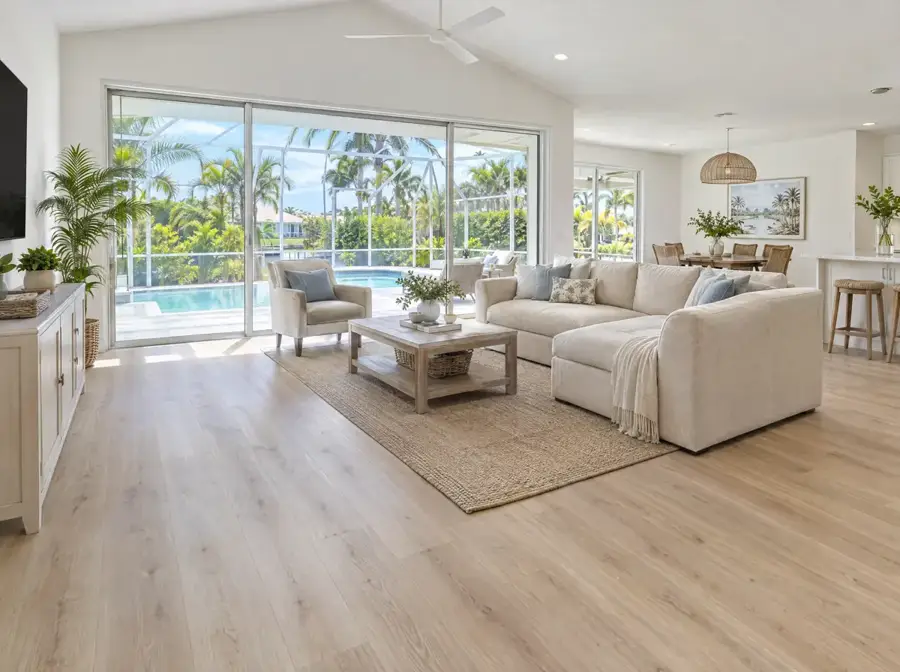
What we mean by luxury vinyl plank
Luxury vinyl plank, or LVP, is a floor made in plank-shaped pieces with a printed wood look on top and a clear wear layer over the print. The planks we install have a rigid SPC core. SPC stands for stone plastic composite: limestone powder bound with vinyl into a stiff board that holds no wood fiber at all.
The industry standard for this kind of product is ASTM F3261, which covers resilient flooring in tile or plank form built around a rigid polymeric core. In plain terms, it’s the category that most “rigid core” and “SPC” boxes fall into. The same product also comes in larger tile shapes, called LVT, for rooms where you’d rather keep a stone or tile look.
The planks click together along their edges and float over the slab. Nothing is glued to the concrete, which is part of why a room can often be finished in a day once the prep is done.
Installing on a South Florida slab
Almost every house we measure on this coast sits on a concrete slab, and many condo units sit on a concrete deck. That’s good news for vinyl plank. Concrete doesn’t flex, so the click joints have a solid base to lock over.
The slab still has to meet the maker’s rules before the first plank goes down. Our installers check three things at the free measurement:
- Flatness. Rigid plank needs a flat floor more than a level one. One maker’s guide, for example, allows no more than 3/16 inch of dip over 10 feet. Humps get ground and low spots get filled with a leveling compound.
- Moisture. Makers set a moisture limit for concrete and name the test, usually an in-slab relative humidity test (ASTM F2170) or a calcium chloride test (ASTM F1869). A slab over the limit gets the moisture barrier the maker calls for.
- What’s on it now. Carpet and pad always come up. Laminate and other floating floors come up too, because you can’t float one floor on top of another. Ceramic tile may stay if it’s sound and the maker allows it.
For more on flatness, patching and moisture barriers, read vinyl plank on a concrete slab.
Why we install an SPC core
Three kinds of product get sold side by side in the plank aisle, and they look almost identical in the box. What separates them is the core.
- SPC (rigid core). Stone and vinyl. Dense, stiff and waterproof through the whole plank. It resists dents from furniture feet and bridges small dips in a slab well.
- WPC. A foamed vinyl core. Softer and a little warmer underfoot, also waterproof, but easier to dent under a heavy dresser or a dropped pan.
- Laminate. A wood-fiber core under a photo layer. Many newer lines resist spills for a time, but the core is still wood fiber, and that’s the part that swells when water gets into a seam.
In a humid climate, with sliders opening onto the lanai and wet feet coming in from the pool, we’d rather put down a core that has no wood in it. The full side-by-side is in SPC, WPC and laminate: which core holds up in Florida.
Picking a wear layer
The wear layer is the clear film on top that takes the scuffs, sand and claws. We offer three thicknesses, measured in mil (thousandths of an inch).
- 6 mil for guest rooms, closets and rooms that see light use.
- 12 mil for most living areas and bedrooms.
- 20 mil for kids, pets and heavy traffic. A 20-mil wear layer over an SPC core can last 20+ years.
Sand tracked in from the beach or the pool deck acts like fine sandpaper under shoes, so a thicker wear layer earns its keep near sliders and entry doors. If you have a large dog, read which wear layer dogs need. For a longer look at lifespan in this climate, see how long vinyl plank lasts in a Florida home.
What happens on install day
Most installs are completed in a single day once your materials arrive. Next-day installation is available. Here’s the order our crews work in:
- Furniture is moved out of the room, or to one side if we’re working in sections.
- Old carpet, pad or loose flooring comes up and goes out with us. If tile is coming out, that’s scheduled as its own step.
- The slab gets its final sweep, patching and any barrier the maker requires.
- Planks go down with the expansion gap the maker specifies at every wall, door frame and fixed object. That gap is what lets the floor move a little as the house warms and cools.
- Baseboard or quarter round goes back on, fastened to the wall and never to the floor. Transitions go in at sliders, bathrooms and any change in floor height.
Kitchen cabinets and islands usually stay put, and the planks run up to them with a gap. Makers generally want the floating floor left free to move, so heavy fixed items don’t go on top of it.
The people doing this work are our own installers. Installed by licensed, insured pros — 20+ years in the trade, 4.5+ star rated, thousands of customer reviews. They’ll walk the finished room with you, show you the transitions and gaps, and go over care. If there are leftover full planks, keep a few for any future repair, stored in a closet inside the air-conditioned house rather than out in a hot garage.
Details that matter on this coast
A few conditions come up in Palm Beach, Martin, St. Lucie and Indian River homes more than they do elsewhere, and they change how a floor is put down.
- Sun through glass. Big sliders and west-facing windows heat the floor in front of them. Makers ask for a wider expansion gap in rooms with strong sun through glass doors, and some flag it in their care instructions. Blinds or UV film help too.
- AC off, house closed. Makers set a temperature range for the room during and after install. If you close the house for the summer, leave the AC set so the room stays within that range. See floors for seasonal homes.
- Transitions at sliders. Slider tracks sit at a fixed height. We plan the edge there so the plank finishes cleanly and the door still rolls.
- Condo buildings. Many associations require approval and a sound-rated underlayment before work starts. We help with the paperwork and we match the rating your association requires. Details are on our condo flooring page.
What luxury vinyl plank costs
Luxury vinyl plank installation runs $5 to $12 per square foot installed, before your discount. That’s an estimate. Most jobs fall in a working range of $6 to $9.50 per square foot before the discount, and $5 to $7.75 per square foot after it, because the 50% off applies to installation labor. A 200 square foot room is roughly $1,200 to $1,900 before the discount.
What moves a job up or down in that range:
- The wear layer and plank you choose
- Removing tile, which takes more labor than pulling carpet
- Leveling a slab that’s out of flat
- Sound-rated underlayment in a condo
- Stairs, closets, and a lot of small cuts around cabinets and door frames
Current offers are 50% off your flooring installation and $1,200 Off + 5% Senior & Military Savings. Financing comes with low monthly payments, 0% interest plans, and same-as-cash offers (for qualified applicants). A full breakdown is in what vinyl plank costs installed in South Florida, and the calculator below gives a range for your square footage. The free measurement gives you the actual number in writing before anything is ordered.
Sources: ASTM F3261: resilient flooring with a rigid polymeric core · Karndean rigid core plank and tile installation guidelines (a manufacturer example) · FEMA NFIP Technical Bulletin 2: Flood Damage-Resistant Materials Requirements.