
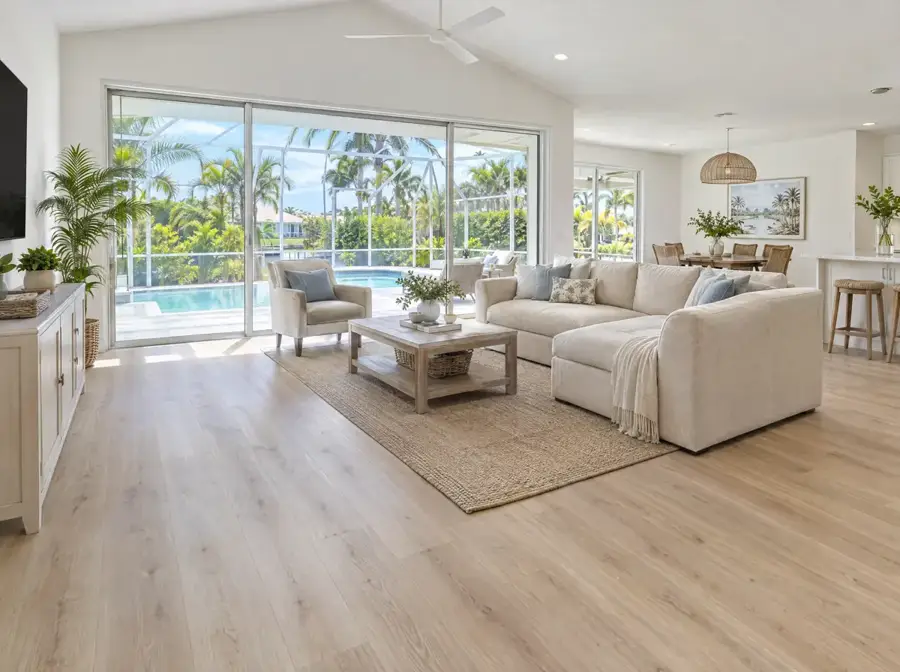
- SPC and WPC are waterproof vinyl cores. Laminate’s core is wood fiber.
- SPC resists dents best and stays the most stable through temperature swings.
- WPC is softer and warmer underfoot but dents more easily.
- We install SPC-core vinyl plank because it suits slabs, humidity and pets.
What the three cores are made of
All three floors look alike from across the room: a printed wood or stone image under a clear top layer. The difference is the core, the thick middle layer that gives the plank its body. That core decides how the floor reacts to water, to a Florida slab and to a dropped cast-iron pan.
SPC stands for stone plastic composite. LX Hausys describes its core as roughly 60% calcium carbonate (limestone) blended with PVC and plasticizers, which makes a thin, very dense plank. WPC stands for wood plastic composite. Its core uses PVC, less limestone, a foaming agent and wood-like material, so it’s lighter and a little softer. Laminate is a different product family. Its core is pressed wood fiber with a photographic layer and a hard melamine surface on top.
- SPC: limestone and PVC. Dense, rigid, thin.
- WPC: PVC foamed with wood-like filler. Thicker, softer, a little warmer underfoot.
- Laminate: wood fiber with a hard wear surface. Firm and scratch-resistant, but the core is still wood.
How each one handles water
This is the question that matters most on this coast. SPC and WPC cores are plastic-based, so a spill, a pet accident or a wet mop won’t make the plank swell. That’s why both are sold as waterproof vinyl.
Laminate is a wood product, and its manufacturers say so in their warranties. The Pergo Classics residential warranty, for example, covers moisture from damp mopping and everyday spills “when removed promptly”, and excludes flooding, standing water, leaking pipes and appliance leaks. Some newer laminates carry stronger water ratings, but the core is still wood fiber. When water reaches the edges and sits, wood fiber swells, and swollen laminate doesn’t shrink back flat.
In a South Florida house, water comes from ordinary places: an ice-maker line, a dishwasher hose, a sweating AC closet, a dog’s water bowl, a kid coming in from the pool. A plastic core shrugs that off. For more on the labels themselves, see our guide to waterproof vs water-resistant flooring.
On a Florida slab
Most single-family homes in the Palm Beaches and on the Treasure Coast sit on a concrete slab poured on grade. Concrete holds and releases moisture from the ground below, and a slab near the coast has plenty of it to give. Makers of rigid vinyl set limits for that moisture. The COREtec Stone installation guide, for one, lists maximum readings for the two standard slab tests and allows an extra 6-mil poly vapor retarder under the floor.
SPC is the easiest of the three to put on a slab. It’s dense, it lies flat, and moisture from below doesn’t swell it. WPC can go on a slab too, within the same moisture limits. Laminate usually needs a vapor barrier underlayment on concrete, and even then its wood core is the part most exposed to a damp slab over time. Our guide to vinyl plank on a concrete slab covers testing and flatness in detail.
Dents, comfort and sound
Density cuts both ways. LX Hausys notes that SPC resists scratches and dents better than WPC, while WPC is more cushioned and more comfortable for long periods of standing. SPC also feels cooler, since the stone-heavy core doesn’t hold warmth. In a house kept at 76 degrees in August, most owners see that as a plus.
Some practical trade-offs:
- A heavy sofa, a piano or a rolling office chair leaves fewer marks on SPC.
- If you cook for hours standing in one spot, WPC or an attached pad softens the feel.
- Both vinyl cores are quieter than laminate’s hard click, especially with an attached acoustic pad.
- Laminate has a very hard surface and handles scratches well, which is its best feature.
Sand is the other everyday wear factor near the beach. Fine grit tracked in from the car or the pool deck acts like sandpaper on any floor. It scratches the clear top layer of vinyl and laminate alike, so a mat at each door and a regular sweep help every one of these floors last longer.
Heat, sun and the slider
Every floating floor moves a little with temperature. The COREtec Stone guide asks for the space to stay between 55 and 85 degrees Fahrenheit, calls for a 1/4 inch expansion gap at the walls on typical rooms, and warns against prolonged direct sun, which can fade and heat the planks. In a Florida room facing west or a living room with a wall of glass sliders, that matters.
SPC is the most dimensionally stable of the three, so it tolerates the swing between an air-conditioned room and afternoon sun better than the others. It still needs blinds or UV film on a hot west-facing slider, and it still needs its expansion gap. We only put vinyl plank in enclosed, climate-controlled rooms, never on an open-air lanai or pool deck. Our guide on vinyl plank in a Florida room explains where it works.
In a condo
Upper-floor condos add one more requirement: sound. Many associations ask for a hard floor with a sound-rated underlayment so the neighbor below doesn’t hear every footstep. Any of the three cores can sit on an acoustic underlayment, but the product and the underlayment have to be approved as a system by the maker. We help with the association’s approval paperwork and we’ll match the rating your association requires. See condo flooring installation for how that process runs.
Side by side
| SPC | WPC | Laminate | |
|---|---|---|---|
| Core | Limestone and PVC | Foamed PVC | Wood fiber |
| Spills and pets | Waterproof plank | Waterproof plank | Wipe up promptly |
| Dent resistance | Best | Good | Good surface |
| Comfort underfoot | Firm | Softest | Firm |
| Temperature swings | Most stable | Stable | Moves with humidity |
| Damp slab | Within maker’s limits | Within maker’s limits | Needs barrier, still at risk |
What we install, and why
We install luxury vinyl plank and tile with a 100% waterproof SPC core. For Florida homes it’s the core that best handles a slab, the humidity, the AC cycle and the traffic from sliders and pool doors. It’s thin, so it fits under door jambs with less trimming, and it’s rigid, so it bridges small dips in the slab better than softer products.
The top layer still matters. We carry 6, 12 and 20 mil wear layers, and 20 mil is the one for kids, pets and heavy traffic. Read which wear layer dogs need before you choose, and see how long vinyl plank lasts for what to expect over the years.
If you’d like to see the options on your own floor, the free in-home measurement and design consultation is the best place to start. Our installers check the slab, look at the rooms and bring samples of each wear layer. The price is an estimate until then: $5 to $12 per square foot installed, before your discount. More on the product is on our luxury vinyl plank installation page.
Sources: LX Hausys: comparing SPC and WPC cores · Pergo Classics laminate residential warranty · COREtec Stone installation guide (flatness, slab moisture, temperature) · FEMA NFIP Technical Bulletin 2: flood damage-resistant materials.