
What waterproof means here
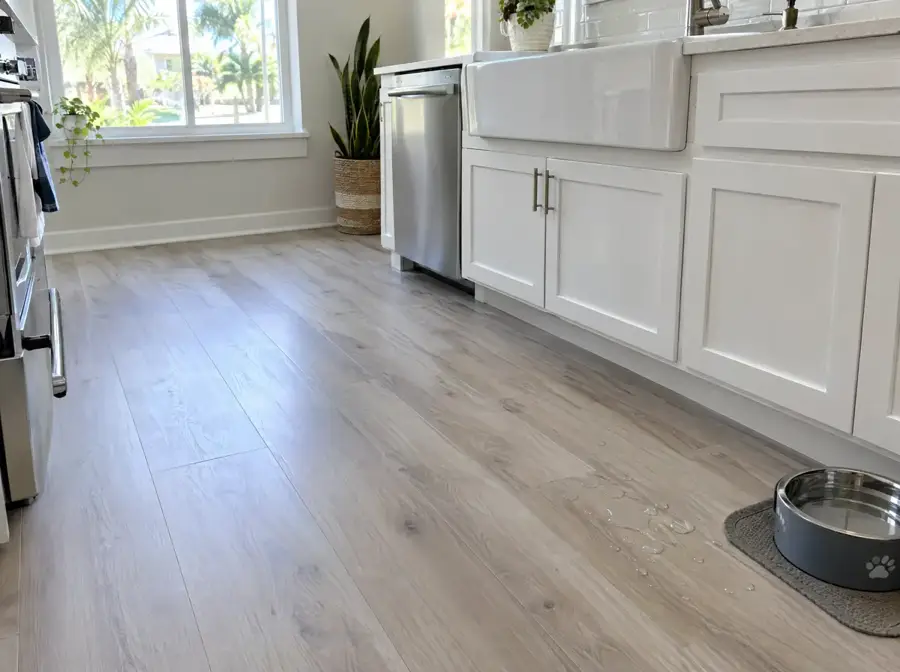
When we say waterproof, we mean the plank itself. The rigid SPC core is stone powder and vinyl, with no wood fiber and no paper to soak up water. A plank that sits in a puddle comes out the same size and shape it went in.
In a Florida house, that covers the everyday water a floor actually meets:
- Spills, mopping and wet feet coming in from the pool
- Pet accidents and water bowls
- A dishwasher, ice maker or toilet supply line that drips before anyone notices
- Months of humid air, including a house that sits closed for the summer
- A slab that gives off some moisture, within the maker’s limit or with the barrier the maker calls for
Waterproof describes the plank. The seams, the perimeter gap and the slab underneath still matter, which is why a leak that runs for days is a different situation from a spill you wipe up. The difference between the two labels on the box is explained in waterproof vs water-resistant flooring.
Rooms where this matters most are the ones with plumbing: kitchens, bathrooms and laundry rooms. Rigid-core makers generally approve their planks for ordinary residential kitchens, baths and laundry rooms, and exclude rooms that stay wet all the time, such as a shower floor or a steam room. In a bathroom, the gap around the tub and toilet can be filled with a flexible sealant where the maker allows it, so mop water and splashes stay on top. Our kitchen and bathroom vinyl flooring page goes room by room.
What waterproof doesn’t cover
Standing floodwater and storm surge are a separate problem, and we’d rather be clear about it up front. FEMA’s Technical Bulletin 2 sorts building materials by how well they survive flooding. It rates ceramic and porcelain tile set in mortar as acceptable, and vinyl sheet or tile as acceptable only when glued down with chemical-set adhesives on concrete. Floating vinyl falls under “all other applications,” which the bulletin rates unacceptable.
The reason isn’t the plank. After a flood, the slab and walls have to dry, and a floating floor holds water underneath. So after a flood the floor usually comes up, the space is dried and repaired by the people who do that work, and a new floor goes down. We don’t do water mitigation, drying or mold work. We install the new floor once the room is dry and repaired. That process is covered on our water-damaged floor replacement page.
Humidity, carpet and laminate
On this coast, the slow damage usually does more harm than the big event. Carpet pad holds moisture from humid air and from the slab, and after a few summers it starts to smell. Laminate has a wood-fiber core, and when water finds a seam, the edges swell and peak. Solid wood on slab is sensitive to both.
Tile handles water well, but it’s hard and cold underfoot, the grout stains, and a cracked 12 or 18 inch tile is difficult to match years later. That’s the main reason owners here move from tile or carpet to vinyl plank.
Air conditioning does a lot of the work in keeping a floor healthy. It pulls moisture out of the air as it cools, which is why a house that’s been closed with the AC off often smells musty when the owners return. A waterproof core doesn’t care about that humidity, but rugs, baseboards and furniture still do, so the habits below help the whole room and not just the floor. For a longer comparison, read the best flooring for Florida humidity.
How the common floors compare
| Floor | Spills and leaks | Humid summers | Comfort underfoot |
|---|---|---|---|
| SPC vinyl plank (what we install) | Waterproof core | Holds its shape | Softer and warmer than tile |
| WPC vinyl plank | Waterproof core | Holds its shape | Softest of the vinyls, dents more easily |
| Laminate | Resists for a time; core can swell | Depends on the product | Comfortable |
| Carpet | Pad soaks it up | Holds moisture and odor | Soft |
| Ceramic tile | Handles water | Unaffected | Hard and cold; grout stains |
Homes that sit closed for the summer
A lot of owners on this coast leave in spring and return in fall. A closed house with the AC off can reach temperatures and humidity that are hard on any floor, and on furniture and drywall too. Plank makers set a temperature range for the room, and many ask that it be kept there after install as well as during it.
A few habits that help while you’re away:
- Leave the AC running at a set temperature and humidity instead of turning it off.
- Shut the water off at the main, or ask your house watcher to check under sinks and around the water heater.
- Close blinds on big sliders so direct sun doesn’t bake the floor in front of them.
If you want the job done before you fly north, tell us your departure date at the measurement and we’ll plan around it. More in floors for seasonal homes that sit closed all summer.
Lanais and Florida rooms
Vinyl plank can go into an enclosed, climate-protected Florida room when the maker’s guide allows it. It doesn’t go on open-air lanais, screened porches, pool decks or anywhere outdoors. Makers exclude outdoor use, and the heat, sun and rain would work against the locking joints.
For an enclosed room with a lot of glass, makers often want extra care. One maker’s guide, for example, calls for a wider expansion gap of 3/8 inch in sunrooms and rooms with direct sun through glass doors. If the room isn’t cooled with the rest of the house, it may not qualify. See vinyl plank on a lanai or Florida room for where it works.
Storm season and scheduling
The Atlantic hurricane season runs from June 1 to November 30, according to the National Hurricane Center. If a storm is forecast, we’ll talk with you about moving the install date. It makes sense to have planks down and the house buttoned up before a storm arrives, and deliveries and crews are affected by the same weather everyone else is.
After a storm, the order matters. A roof leak or wet slab gets fixed and dried first. Then we measure, and then the new floor goes in. If you’re filing an insurance claim, take photos of the old floor before anything is removed, and keep a piece of it if your adjuster asks. We can give you a written measurement and estimate for the replacement once the room is dry.
For owners who are away in storm season, a house watcher who can check for roof leaks and wet floors after a storm passes is worth arranging. The sooner water is found and dried, the better the odds for the slab, the drywall and everything else in the room.
What waterproof flooring costs
Waterproof vinyl plank runs $5 to $12 per square foot installed, before your discount. That’s an estimate, and most jobs land in a working range of $6 to $9.50 per square foot before the discount and $5 to $7.75 per square foot after it, since the 50% off applies to installation labor. A 200 square foot room is roughly $1,200 to $1,900 before the discount.
Offers: 50% off your flooring installation, plus $1,200 Off + 5% Senior & Military Savings. Financing includes low monthly payments, 0% interest plans, and same-as-cash offers (for qualified applicants). The calculator below gives a range for your square footage, and the free measurement gives you the number in writing.
Sources: FEMA NFIP Technical Bulletin 2: Flood Damage-Resistant Materials Requirements · Karndean rigid core plank and tile installation guidelines (a manufacturer example) · NOAA National Hurricane Center: tropical cyclone climatology · ASTM F3261: resilient flooring with a rigid polymeric core.