
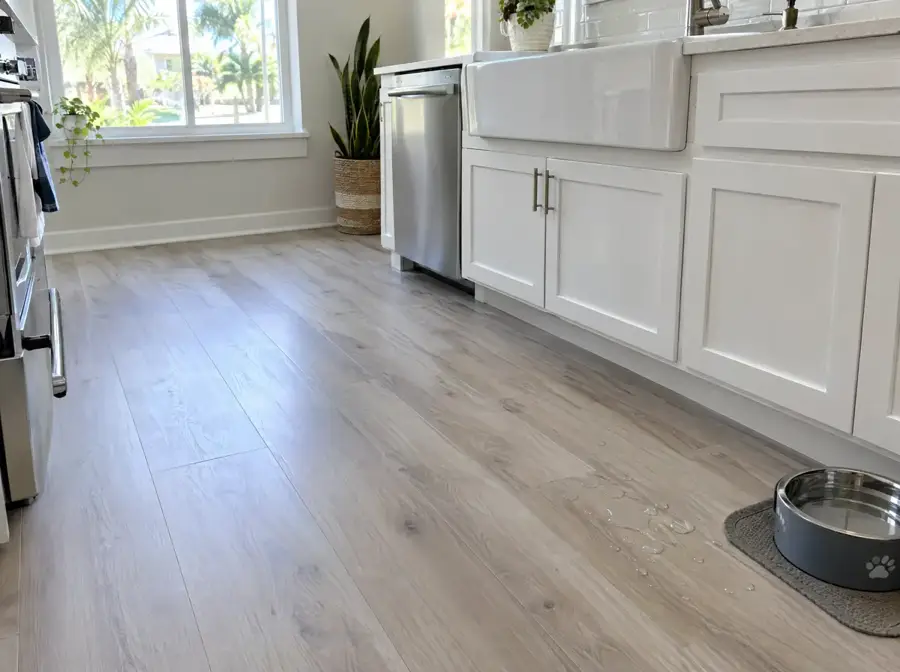
- SPC vinyl plank and tile don’t absorb moisture. Laminate, wood and carpet do.
- The EPA recommends indoor humidity below 60 percent, ideally 30 to 50.
- Air conditioning is what dries a Florida house, so keep it running.
- Waterproof covers spills, leaks and humidity. Floodwater is a different matter.
What humidity does to a floor
South Florida air carries a lot of water for much of the year. Indoors, the air conditioner does two jobs at once. UF/IFAS Extension explains that as warm, humid air passes over the AC’s evaporator coils, moisture condenses and drains away before the cooler, drier air goes back into the house. When the AC runs normally, the indoor air stays fairly dry. When it’s off, undersized or struggling, the house soaks up moisture fast.
Floors feel that in two directions. Humid air works on the surface, and a concrete slab gives off moisture from the ground below. Materials made from wood or fiber take that moisture in, swell, and shrink again as it leaves. Porous materials hold it and can grow mold. A floor that doesn’t absorb water sidesteps most of the problem.
The humidity numbers to aim for
The EPA recommends keeping indoor relative humidity below 60 percent, ideally between 30 and 50 percent. UF/IFAS Extension suggests keeping it around 55% or lower in Florida homes. Above those levels, mold and mildew get easier to grow and the house feels clammy.
A small digital humidity gauge costs little and tells you where your house sits. If it reads high with the AC running, have the system checked. UF/IFAS also points to clean, free-flowing AC drip pans and drain lines as part of keeping moisture under control. A clogged condensate line is also one of the common sources of a wet floor in a Florida hallway closet.
How the common floors compare
| Floor | Humidity | Spills and leaks | Estimated life (InterNACHI, Florida) |
|---|---|---|---|
| SPC vinyl plank | Stable | Waterproof plank | About 25 years |
| Porcelain or ceramic tile | Stable | Waterproof surface | 75 to 100 years |
| Laminate | Wood-fiber core moves | Wipe up promptly | 15 to 25 years |
| Solid or engineered wood | Swells and shrinks | Vulnerable | 50 to 100+ years with care |
| Carpet | Holds moisture | Absorbs it | 8 to 10 years |
Waterproof vinyl plank: our pick
A rigid SPC core is made mostly of limestone and PVC. It doesn’t absorb water, so humid air and a damp slab don’t make it swell or cup. It goes straight over concrete within the maker’s moisture limits, it’s warmer and softer underfoot than tile, and it can be installed in a day in most rooms. That’s why it’s the floor we install.
It has limits that are worth knowing. The plank is waterproof, but the slab under it isn’t sealed by it, so water that runs under the edges needs to be dried. Makers set a temperature range for the floor, so the AC has to keep running. And prolonged direct sun can fade and heat the planks, so a west-facing slider needs blinds or film. See SPC, WPC and laminate for how the cores differ.
Room by room, the case for a waterproof floor is strongest where water shows up in ordinary life. The kitchen has the ice maker, the dishwasher and the sink. Bathrooms and laundry rooms have supply lines and splashing. The hall closet often holds the AC air handler and its condensate drain. The family room opens onto the lanai and the pool. A floor that doesn’t care about a wet footprint or a slow drip is a practical choice in each of these, and it lets one floor run through the whole house without a change at every doorway.
Tile: durable, with trade-offs
Porcelain and ceramic tile handle humidity well and last for decades. That’s why so many Florida homes already have it. The trade-offs are the ones owners tell us about: it’s hard and cold underfoot, grout lines stain, tiles crack when the slab moves, and a dropped glass doesn’t survive. For owners aging in place, a hard fall on tile is a real concern.
Replacing tile means removing it, which is heavy, dusty work. Have older tile and mastic tested before anyone tears it out. In some cases vinyl plank can go over sound, flat tile where the maker allows it. See tile removal and replacement.
Laminate, wood and carpet
Laminate looks like wood and resists scratches, but its core is wood fiber. The Pergo Classics residential warranty, for example, covers everyday spills removed promptly and excludes standing water, leaks and flooding. In a humid house with a slab below, that’s a narrow margin. Solid and engineered wood are beautiful and long-lived with care, but they move with every change in humidity and don’t tolerate water on a slab.
Carpet is the floor that struggles most. It holds moisture and whatever grows in it, and the EPA notes that porous materials like carpet may have to be thrown away if they become moldy. InterNACHI’s Florida chart gives it 8 to 10 years. Our guide on why carpet struggles in Florida humidity goes further.
Closed-up houses and storms
A house left closed for the summer is the hardest test for any floor. Without daily AC, humidity climbs and stays up for weeks. A waterproof floor won’t swell, but walls, cabinets and furniture still suffer. Leave the AC on at a reasonable setting, keep the humidity in check and have the house checked after storms. See floors for seasonal homes.
Storms are a separate matter. Waterproof means spills, leaks, pets, humidity and a damp slab. Standing floodwater and storm surge are different. FEMA’s Technical Bulletin 2 rates vinyl sheets and tiles as acceptable flood damage-resistant materials only when they’re homogeneous and set with chemical-set adhesives on concrete. A floating click floor isn’t installed that way, and laminate and wood floors are rated unacceptable. After a flood, the space has to be dried and repaired before any new floor goes in. See water-damaged floor replacement.
Planning a floor for your house
At the free in-home measurement and design consultation, we check the slab, look at the rooms that see sun and water, and talk through how you use the house. Then we write up an estimate. As an estimate, waterproof vinyl plank runs $5 to $12 per square foot installed, before your discount. A 200 square foot room is roughly $1,200 to $1,900 before the discount.
On installation day, the house should be at its normal living temperature with the AC running. Makers set a temperature range for storing and installing the planks, and the boxes should sit inside the house, not in a hot garage. Our crews check the slab, prep it to the maker’s flatness rules and lay any vapor retarder the product calls for. Most installs are completed in a single day once your materials arrive.
For kids, pets and heavy traffic, we recommend a 20 mil wear layer, which over an SPC core can last 20+ years. Learn more on our waterproof flooring installation page, or read waterproof vs water-resistant flooring before you shop.
Sources: EPA: a brief guide to mold, moisture and your home · UF/IFAS Extension: understanding Florida homes (humidity and AC) · InterNACHI: estimated life expectancy chart for Florida homes · FEMA NFIP Technical Bulletin 2: flood damage-resistant materials · Pergo Classics laminate residential warranty.