
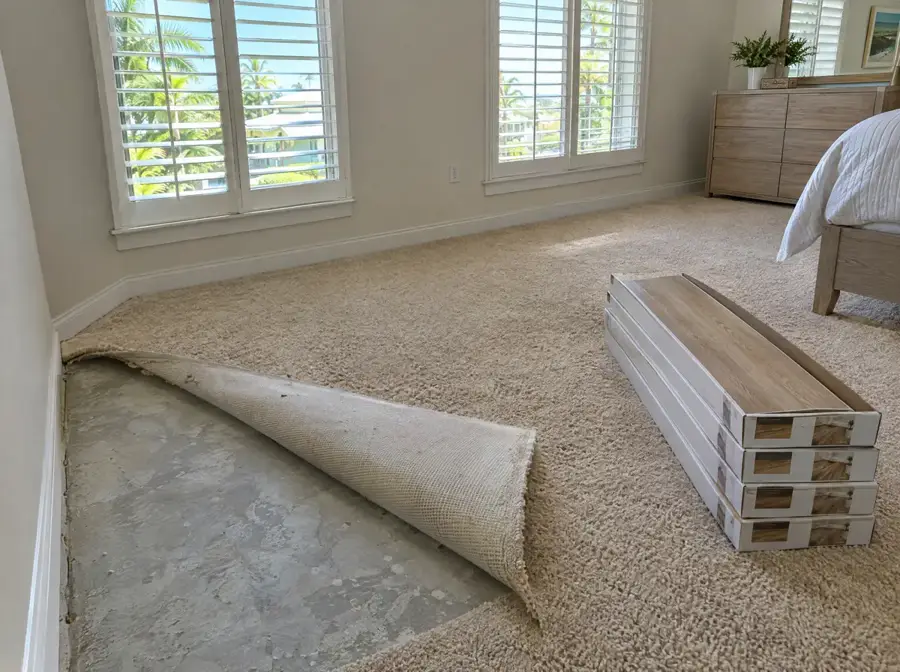
Why carpet is a hard fit on a Florida slab
Most homes on this coast sit on a concrete slab poured straight onto the ground. Wall-to-wall carpet on that slab has a pad under it, and the pad sits against concrete that stays cool and passes a little moisture upward all year. Put that together with humid outdoor air and you have a floor that never fully dries out.
That’s why so many owners call us about carpet that smells musty after a few seasons, a pad that has gone flat and crumbly, or dark lines along the baseboards. None of it is a sign that the house is neglected. Carpet was simply chosen for a colder, drier climate than the one it’s sitting in.
Rigid-core (SPC) vinyl plank has no fibers, no pad to hold water and no wood in its core. It floats over the slab, it takes a damp mop, and it doesn’t care about the humidity that carpet soaks up.
Humidity, AC and the closed-up house
The EPA recommends keeping indoor humidity below 60 percent, ideally between 30 and 50. In a South Florida summer the air conditioner does most of that work. When it cycles less, as it often does in a home closed up for the season, the carpet and pad are the first things to take on moisture.
Seasonal owners know the pattern. You set the thermostat, lock up in spring, and come back in the fall to a smell that the carpet cleaner can’t fully remove. The EPA notes that absorbent materials like carpet may have to be thrown away once mold gets into them, because it grows into the fibers and backing where cleaning can’t reach.
A hard, waterproof floor removes that whole category of worry. There’s more on the humidity side in why carpet struggles in Florida humidity, and on setting up a home you leave for months in flooring for seasonal homes.
What happens on install day
Most installs are completed in a single day once your materials arrive. Here is what our crews do between the old carpet and the new floor.
- Carpet, pad and tack strip come out. The carpet is cut into rolls, the pad is lifted, and the wooden tack strip nailed around the edges of the room is pulled. Everything is hauled away.
- The slab gets a close look. Nail holes from the tack strip are filled. Rigid-core makers set a flatness limit, for example 3/16 inch within 10 feet in one widely used installation guide, so dips get patched and high spots get evened out.
- We check what else is under there. In older homes, carpet sometimes covers an earlier floor such as small vinyl tiles or sheet goods. Have older tile and mastic tested before anyone tears it out. Often the simplest answer is to leave it in place and float over it.
- Underlayment and plank go down. The underlayment the maker specifies goes over the slab, then the planks click together with an expansion gap at every wall.
- Trim and transitions finish it. Baseboard or quarter-round covers the gap, and transitions go in where the plank meets tile at a kitchen, a bathroom or a slider.
Doors are the one thing people forget. Carpet is thicker than plank, so interior doors usually clear the new floor with room to spare. Where a door was cut short for carpet, the gap at the bottom may look larger afterward. The installer points that out at the measurement.
Pets, sand and pool traffic
Carpet holds on to whatever comes in on feet and paws. On this coast that means beach sand, pool water, wet dogs and the occasional accident that soaks through to the pad, where no amount of surface cleaning will reach it.
Vinyl plank sheds all of that. Sand sweeps up, pool water wipes off, and a pet accident stays on the surface of a waterproof plank instead of sinking into the slab. The piece that matters most for pets is the wear layer, the clear top coat that takes the scratches. We offer 6, 12 and 20 mil. The 20 mil layer is the one for kids, pets and heavy traffic, and a 20-mil SPC floor can last 20+ years. See which wear layer works with dogs for how to choose.
Fewer trip points for aging in place
The CDC reports that falls are the leading cause of injury death for adults 65 and older. Worn carpet with a loose edge, a rumpled seam or a thick pad is a common thing to catch a foot or a walker wheel on.
A plank floor is flat, firm and even from room to room. Walkers, canes and wheelchairs roll across it without dragging. The details that make the difference are low-profile transitions at doorways, a matte finish that isn’t slick when dry, and a surface you can clean without getting down on your knees. Our guide to floors for aging in place goes through each of these, including where throw rugs belong and where they don’t.
Carpet against the alternatives
Here’s how the usual choices compare in a humid, slab-on-grade home.
| Floor | Humidity | Pets and spills | Underfoot |
|---|---|---|---|
| Carpet and pad | Absorbs it | Soaks into the pad | Soft, warm |
| Laminate | Wood core can swell | Wipe up fast | Hard, can sound hollow |
| Ceramic tile | Unaffected | Unaffected | Cold, hard on joints |
| SPC vinyl plank | Unaffected | Waterproof surface | Firm, quieter than tile |
Tile handles water just as well, and many homes here already have it in the main rooms. Plank is the usual choice for the carpeted bedrooms because it matches the feel people want in a bedroom: quieter and a little softer than tile, and warm enough for bare feet in the morning.
Carpet in a condo
In an upper-floor condo, carpet is doing a second job: keeping footsteps from carrying into the unit below. That’s why most associations have rules about replacing it with a hard floor, usually a sound-rated underlayment and board approval before work begins.
We help with the association’s approval paperwork and install the sound-rated underlayment the building requires. We match the rating your association requires, and we plan the work around the building’s set hours. We can’t promise a board will approve a job, but we can make sure what you hand in is complete. More on that on our condo flooring page.
Before a sale or an estate clear-out
Worn carpet is one of the first things buyers notice in a listing photo and one of the first things they price into an offer. When a home is being sold, or cleared after a parent’s move, replacing the carpet is often the change that makes the rooms look cared for.
It’s a decision worth making with numbers in front of you. Our guide to new floors before selling a Florida home goes through when it makes sense and when a buyer would rather choose their own. Keep in mind that the Limited Lifetime Warranty covers you as the owner and doesn’t transfer to the next buyer.
What replacing carpet with vinyl plank costs
Replacing carpet with vinyl plank typically runs $5 to $12 per square foot installed, before your discount. That’s an estimate. A 200 square foot room is roughly $1,200 to $1,900 before the discount. The things that move a carpet job within that range:
- How many rooms and closets, and how many doorways need a transition
- Slab patching once the tack strip and pad are gone
- An older floor found under the carpet that has to be covered or tested
- The wear layer you choose, and sound-rated underlayment in a condo
- Stairs, if the carpet runs up to a second floor
Our current offer is 50% off your flooring installation, and the $1,200 Off + 5% Senior & Military Savings applies for seniors 60+ and active or retired military. Financing includes low monthly payments, 0% interest plans, and same-as-cash offers (for qualified applicants). Use the calculator for a range on your square footage, then book a free measurement for the number in writing.
Sources: EPA: A Brief Guide to Mold, Moisture and Your Home · CDC: Older adult falls · RW Supply+Design rigid core vinyl installation guidelines · EPA: Protect your family from asbestos