
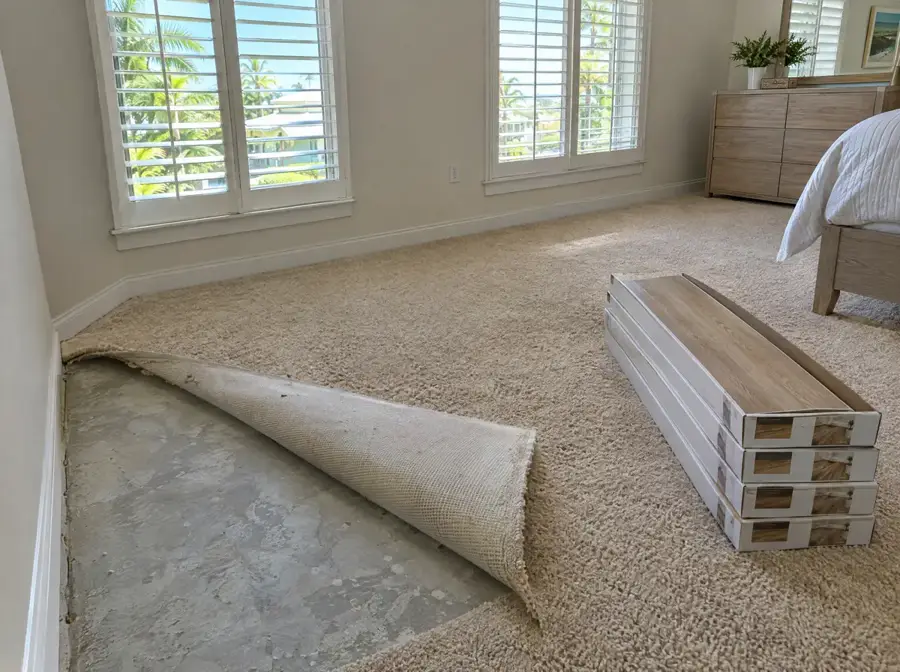
- The EPA suggests keeping indoor humidity below 60%, ideally 30% to 50%. Carpet has a hard time when a house sits above that.
- Wet carpet and pad that aren’t dried within 24 to 48 hours can grow mold, and moldy carpet may have to be thrown away.
- The pad is the weak spot. It soaks up water and is very hard to clean.
- Waterproof vinyl plank on a dry, tested slab takes humidity, spills and pet accidents far better.
Why carpet holds on to moisture
Carpet is a thick layer of fibers sitting on a foam or fiber pad. Both have a huge amount of surface area, and both take up water vapor from the air when the air is humid. When the air dries out, they give some of it back. In a climate like ours the air rarely dries out for long.
The EPA’s guidance on mold and moisture suggests keeping indoor relative humidity below 60 percent, ideally between 30 and 50 percent. A Florida house with the AC running steadily can stay in that range. A house where the thermostat is set high, the AC is oversized and short-cycles, or the doors to the lanai stay open all afternoon often sits above it.
Tile, stone and vinyl plank shrug that off. Carpet doesn’t. It keeps a little of every humid week, every spilled glass and every wet swimsuit that crossed it on the way from the pool.
The musty smell, and where it comes from
UF/IFAS Extension describes mildew plainly: it has a musty odor, it grows best in moist, warm air like we have in Florida, and it does well wherever moisture sits. Bedrooms and closets with carpet are classic spots, because air moves less there and furniture covers large parts of the floor.
The smell usually lives in the pad and the backing, not the top of the fibers. That is why a steam cleaning can make a room smell better for a week and then the odor comes back. The cleaning adds water to the same layer that was holding it.
Pets make it worse. An accident soaks through the carpet into the pad, and from there into the pad seams and the tack strip at the wall. Cleaning the surface doesn’t reach it.
Homes closed up for the summer
Many owners on this coast close the house for the hot months and head north. That is exactly the season when humidity outside is highest and rain is most frequent. If the AC is set high to save power, or a storm knocks the power out for a few days, indoor humidity climbs and carpet has months to soak it up.
The first sign is often a musty smell when the door opens in the fall, before anything looks wrong. Sometimes it airs out. Sometimes the pad has picked up enough moisture that the smell stays.
If you close the house, a few habits help any floor: keep the AC running at a moderate setting rather than off, ask a neighbor or house watcher to check it after storms, and keep supply lines to toilets and sinks in good shape. Our guide to floors for seasonal homes goes into the flooring side of that decision.
When carpet actually gets wet
Humidity is the slow problem. Water is the fast one. A washing machine hose, a toilet supply line, a roof leak in a summer storm or water tracked in from the pool can soak a section of carpet in minutes.
The EPA says that if wet or damp materials are dried within 24 to 48 hours after a leak or spill, in most cases mold will not grow. It also says porous materials such as carpet may have to be thrown away if they become moldy. UF/IFAS Extension’s guide to flood-damaged carpet adds that carpet soaked by clean rainwater can often be cleaned, carpet soaked by contaminated water should usually be discarded, and the padding is nearly impossible to clean, so it should be replaced.
We don’t dry or remediate wet rooms. If a room is wet now, call a water mitigation company first. Once the space is dry and any repairs are done, we can talk about the new floor. Our page on water-damaged floor replacement explains that order.
Carpet on a slab
Most homes here sit on a concrete slab poured on grade. Concrete passes water vapor up from the ground, slowly and constantly. Tile doesn’t care. Carpet laid straight over the slab, with only a pad in between, sits right in that vapor path.
That doesn’t mean every slab is damp. Many are perfectly dry. It does mean a floor that absorbs moisture is a riskier match for a slab than one that doesn’t. Before we install anything on concrete, the slab is checked against the flooring maker’s written moisture limit. Shaw’s installation guidelines for SPC products, for example, accept up to 90 percent relative humidity by the ASTM F2170 test, or 8 pounds by the ASTM F1869 calcium chloride test.
What changes with vinyl plank
Luxury vinyl plank with a rigid SPC core (stone and plastic composite) doesn’t absorb water. There’s no pad to soak up a spill, so an accident gets wiped off the surface and that’s the end of it. The core doesn’t swell in humid air the way a wood-fiber laminate core can.
- Spills and pets: they stay on top, where you can see them and clean them.
- Humidity: the plank doesn’t hold moisture from the air, so there’s nothing to go musty.
- Allergies and dust: a hard floor can be swept and damp-mopped instead of deep-cleaned.
- Wear: we install wear layers of 6, 12 and 20 mil. The 20 mil layer is for kids, pets and heavy traffic, and 20-mil SPC can last 20+ years.
Waterproof has limits worth saying clearly. It covers spills, leaks, pets, humidity and a damp slab within the maker’s limit. Standing floodwater or storm surge is a different matter, and FEMA Technical Bulletin 2 does not list floating vinyl plank as a flood damage-resistant material. Excess moisture in the slab itself still has to be dealt with, because the plank won’t fix a wet slab. It just won’t be ruined by a spill on top.
Some owners keep carpet in bedrooms because it’s soft and quiet underfoot. That’s a fair choice, especially in a well air-conditioned room. Area rugs over vinyl plank give some of that softness and can go out to be cleaned.
What the switch costs
We estimate carpet-to-vinyl-plank jobs at $5 to $12 per square foot installed, before your discount. Our working range is $6.00 to $9.50 per square foot before the discount and about $5.00 to $7.75 after, because the 50% off your flooring installation applies to installation labor. A 200 square foot room is roughly $1,200 to $1,900 before the discount.
That includes pulling the old carpet, pad and tack strip and hauling them away. Slab leveling, if the concrete needs it, is priced at the measurement. You can run your own rooms through the cost calculator to get a feel for the range before anyone visits. Every figure is an estimate until the room is measured.
What happens at the measurement
At the free in-home measurement, the installer measures each room, looks at where the carpet meets tile or other floors, and checks the slab once a corner of carpet can be lifted. If there’s older tile or mastic under the carpet, have it tested before anyone tears it out. Condo owners should mention the association early, because we help with the approval paperwork and install the sound-rated underlayment the building requires.
More on the full job is on our carpet to vinyl plank replacement page. When you’re ready, book a free measurement. Most installs are completed in a single day once your materials arrive.
Sources: EPA: a brief guide to mold, moisture and your home · EPA: flood cleanup to protect indoor air and your health · UF/IFAS Extension: cleaning flood-damaged carpets and rugs (DH 524) · UF/IFAS Extension: controlling mildew (FCS5232) · Shaw installation guidelines for SPC products.