
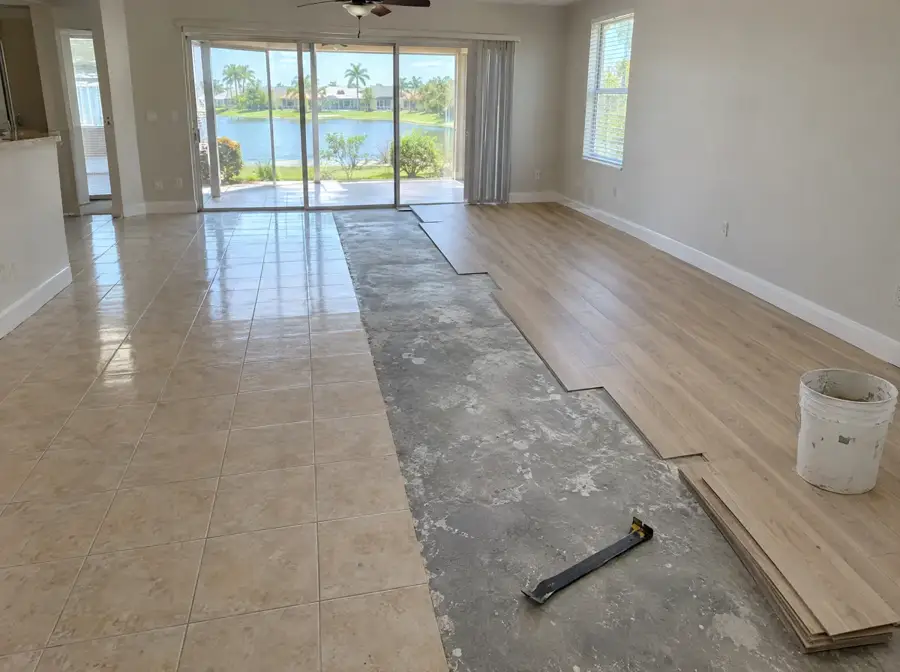
- Makers such as Shaw and Karndean allow SPC over sound ceramic tile, within grout and flatness limits.
- We check bond, cracks, flatness, grout width, moisture and height at the measurement.
- Loose, hollow or badly uneven tile, or height problems, mean removal.
- If older layers are under the tile, have them tested before anyone tears them out.
The short answer: often, yes
Many homes on this coast have 12 to 18 inch ceramic or porcelain tile set on a concrete slab. When that tile is still tight to the slab, reasonably flat and dry, a floating rigid core vinyl plank floor can often go right over it. That skips the noise, dust and time of tearing out tile.
Manufacturers allow it within limits. Shaw’s installation guidelines for its SPC products say the planks can go over existing ceramic or porcelain tile with grout joints up to 1/4 inch wide, and that wider joints should be filled with a cementitious patching compound. Karndean’s rigid core guide says to make sure tile is firm, dry and clean, fix any loose tiles, and level grout lines more than 3/16 inch wide or deep. The two makers set slightly different limits, which is why we check the instructions for the product you choose.
Whether your tile qualifies is something we decide at the measurement, room by room.
Going over tile has real advantages for a household that is living in the home during the work. There’s no jackhammer, far less dust, and no dumpster in the driveway. The job is usually shorter, and once your materials arrive, most installs are completed in a single day. For a condo, it can also mean fewer hours of loud work for the neighbors, though the association’s rules still apply.
What we check at the measurement
- Bond. We tap across the floor listening for hollow sounds. A few hollow tiles can be fixed; a lot of them mean the tile is letting go of the slab.
- Cracks. A hairline crack in a sound tile isn’t a problem. Cracks that run across several tiles in a line can point to movement in the slab, which we look at more closely.
- Flatness. Rigid core needs a flat base. Shaw calls for flatness within 3/16 inch over 10 feet, or 1/8 inch over 6 feet. Tiles set unevenly, with raised edges, may need a leveling compound over them, or the tile may have to come out.
- Grout lines. Wide or deep grout joints can telegraph through as faint lines in the new floor, so they get filled to the maker’s limit.
- Moisture. Tile can hide a damp slab. If there’s a history of leaks, we want to know.
- Height. Adding a plank on top of tile raises the floor. We check every door, transition and appliance.
The height question: doors, appliances, transitions
A rigid core plank adds height to the floor, and on top of existing tile that height stacks up. It is the detail that most often decides whether tile can stay.
- Interior doors may need trimming at the bottom to swing freely.
- Exterior doors and sliders need enough clearance; the threshold may limit how high the floor can go.
- Dishwashers can get trapped under a counter if the floor in front rises. We check the space before we start.
- Transitions into rooms that keep their tile or carpet need a proper reducer, so the change in level is gentle and easy to see.
- Toilets need the flange height checked so the seal still works when the toilet sits on the new floor.
If the whole house is getting the new floor, height is usually easy to manage. If the new floor stops at a room that keeps its tile, the transition needs more thought, especially for anyone who uses a walker or is careful about tripping.
When the tile should come out
Some floors aren’t good candidates for an overlay. We recommend removal when:
- Large areas of tile are hollow, loose or tented up from the slab.
- The tile is too uneven to bring within the maker’s flatness limit.
- The height would trap an appliance or leave a door or slider unworkable.
- There is a moisture problem in the slab that needs to be found and fixed.
- Your condo association’s rules call for a specific underlayment installed directly on the slab.
We remove and haul away old tile as part of our tile removal and vinyl plank replacement service. Removal takes longer, makes noise and dust, and adds cost, so we recommend it only when the floor calls for it.
A caution about older layers
Ceramic tile over a slab is usually straightforward. But some homes have older layers: a vinyl tile or sheet floor under the ceramic, or an older adhesive in a room that was redone. The EPA lists vinyl floor tiles, the backing on vinyl sheet flooring, and adhesives among products that may contain asbestos, and says you generally can’t tell by looking.
Leaving an older floor in place under a new one avoids disturbing it; the EPA advises installing new flooring over asbestos flooring when possible. If anything older has to come up, have older tile and mastic tested before anyone tears it out. Never sand, grind or scrape it. We don’t test or abate; our guide on older floor tile and mastic covers this in detail.
Kitchens, baths and cabinets
In kitchens, the plank usually runs up to the cabinets and not under them, so the cabinets stay put. Shaw’s guidelines say that if cabinets or islands are installed on top of its SPC flooring, that area has to be glued down, including two feet beyond, rather than floated. Where that matters, we plan it before the job.
In bathrooms, the plank goes around the toilet and up to the tub or shower, with the edges sealed as the maker directs. Waterproof planks suit these rooms, as long as the tile under them is sound.
What it costs
As an estimate, vinyl plank runs $5 to $12 per square foot installed, before your discount. A 200 square foot room is roughly $1,200 to $1,900 before the discount. Most jobs land in a working range of $6.00 to $9.50 per square foot before the discount, and about $5.00 to $7.75 after it, because the 50% off applies to installation labor. None of these numbers is a quote. The real figure comes from the free in-home measurement.
Going over sound tile usually costs less than removing it, because there’s no demolition or haul-away. If the tile has to come out, removal and any slab prep are part of the estimate. The current offer is 50% off your flooring installation and $1,200 Off + 5% Senior & Military Savings, with financing including low monthly payments, 0% interest plans, and same-as-cash offers (for qualified applicants). Try the cost calculator or book the free measurement. The Limited Lifetime Warranty covers you as the owner and doesn’t transfer to the next buyer.
Sources: Shaw installation guidelines for SPC products · Karndean rigid core plank and tile installation guidelines (USA) · EPA: protect your family from exposures to asbestos · EPA: learn about asbestos