
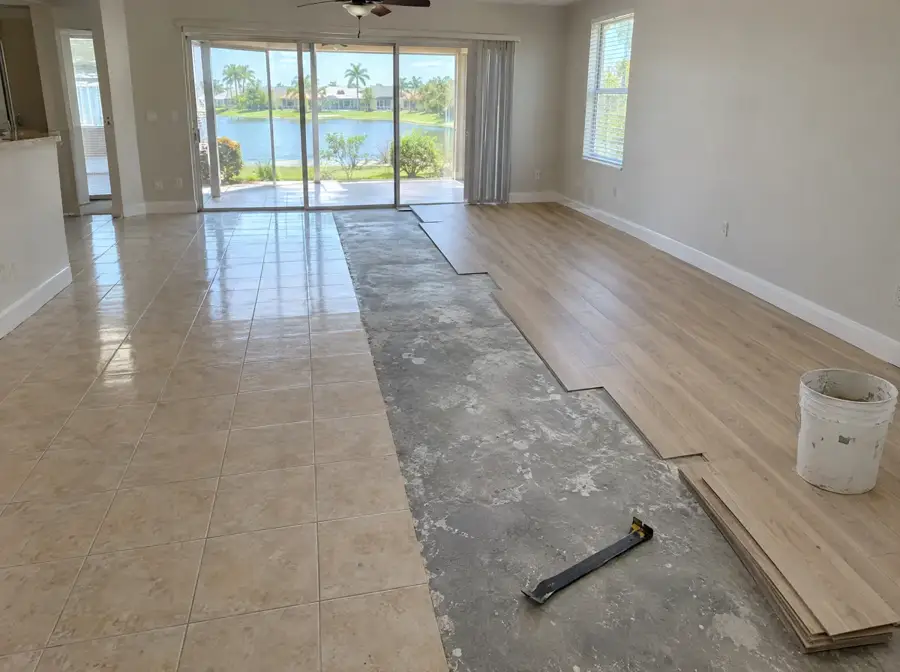
- The EPA lists vinyl floor tiles, sheet vinyl backing and adhesives among possible asbestos products.
- Intact, undisturbed material is generally not the problem; disturbing it is.
- Testing should be done by a trained, accredited professional, never a DIY sample.
- Condo buildings fall under Florida’s asbestos renovation rules; talk to your association first.
Why older floors get extra care
When an older floor is about to be replaced, the question isn’t only what goes down next. It’s what is coming up. Some older flooring products and the adhesives under them were made with asbestos, and the risk comes when those materials are broken up.
The EPA lists vinyl floor tiles, the backing on vinyl sheet flooring, and adhesives among the products that may contain asbestos. It also says that, generally, you can’t tell whether a material contains asbestos simply by looking at it, unless it’s labeled. Color, size and age are clues at best.
The EPA explains when these materials become a concern: when they are disturbed, damaged, removed improperly, repaired, cut, torn, sanded, sawed, drilled or scraped. Left intact and undisturbed, material in good condition is generally not the problem. That is why the order of events matters so much: test first, then decide.
Where it turns up in Florida homes
Most slab homes on this coast have ceramic or porcelain tile, carpet or laminate on top. Those surface floors are often not the concern. The question is what sits under them or in the rooms nobody redid.
When carpet or tile comes up in an older home, what’s underneath is sometimes an older vinyl tile, a sheet vinyl floor, or a dark adhesive left from a floor that was removed years ago. An earlier layer can turn up in any room that was covered over instead of stripped, including closets and laundry rooms that were never part of a remodel. We can’t tell you what those materials contain, and neither can anyone else by eye. Only a lab test of a properly taken sample can.
Leaving it in place is often an option
The simplest way to avoid disturbing an older floor is to not disturb it. The EPA’s guidance for homeowners says to leave undamaged asbestos-containing materials alone, and not to sand or try to level asbestos flooring or its backing. For flooring that needs replacing, it says to install new floor covering over it, if possible.
A floating rigid core vinyl plank floor fits that advice well. The planks lock together on top of the existing floor, with nothing sanded or scraped, as long as the old floor is flat, firm and allowed by the plank maker’s instructions. Our guide to vinyl plank over ceramic tile explains how we judge whether an existing floor can stay.
Testing: who and how
If an older floor has to come up, or you just want to know, have it tested before anyone tears it out. The EPA’s advice on how:
- Use a professional. The EPA says a trained and accredited asbestos professional should take the samples, and that taking samples yourself is not recommended.
- Keep testing separate from removal. It advises that a professional hired to assess the need for repair or removal should not be connected with the firm that does the removal.
- Ask for proof of training. The EPA says each person doing the work should provide proof of accreditation. Federal law doesn’t require accreditation for work in detached single-family homes, but some states and localities do.
We don’t test for asbestos and we don’t do abatement. Those are separate trades with their own training and rules.
Condos and multi-unit buildings
The rules are stricter in larger buildings. The Florida Department of Environmental Protection’s asbestos FAQ explains that the federal asbestos rules for renovation and demolition exempt isolated residential buildings with four or fewer units, but condominiums and co-ops are covered, with the condo board treated as the owner.
In Palm Beach County, the Florida Department of Health enforces those rules. Its program page says buildings containing condominiums are included in the definition of a facility, that a thorough asbestos inspection is needed to complete a written notification, and that notifications are due at least ten working days before regulated work begins.
So if you own a condo, talk to the association before any old flooring comes out. It may already have survey results for the building, or its own process. Our condo approval guide covers the rest of the paperwork.
What never to do
Whatever the age of the floor, some things should never happen to older tile or its adhesive. Shaw’s installation guidelines carry a clear warning against sanding, dry sweeping, dry scraping, drilling, sawing, bead blasting or mechanically chipping existing resilient flooring, backing or adhesive, because these products may contain asbestos fibers or crystalline silica.
- Don’t sand, grind or scrape older tile or mastic.
- Don’t use solvents or adhesive removers on old adhesive to “clean it up” before a new floor.
- Don’t take a sample yourself.
- Don’t let anyone begin tear-out until you know what’s there.
Where we fit in
Our part starts once you know what you are dealing with. If the existing floor can stay, we install over it where the maker allows. If testing shows no asbestos, we can remove and haul away the old tile and carpet as part of our tile removal and vinyl plank replacement service. If it shows asbestos and the floor has to come out, that removal is work for a licensed abatement contractor, and we install the new floor once the space is cleared.
Ask us at the free measurement and we’ll point out anything that looks like an older layer, so you can decide on testing before the job is scheduled.
If testing is needed, it can change the timeline, so it helps to start early. Seasonal owners in particular may want the test done while they are in residence, with results in hand before they book the install. A clear answer up front keeps the rest of the job predictable, and it means nobody on your floor is guessing.
What it costs
As an estimate, vinyl plank runs $5 to $12 per square foot installed, before your discount. A 200 square foot room is roughly $1,200 to $1,900 before the discount. Most jobs land in a working range of $6.00 to $9.50 per square foot before the discount, and about $5.00 to $7.75 after it, because the 50% off applies to installation labor. None of these numbers is a quote. The real figure comes from the free in-home measurement.
Testing and any abatement are separate from our estimate and are paid to those firms directly. The current offer is 50% off your flooring installation and $1,200 Off + 5% Senior & Military Savings, with financing including low monthly payments, 0% interest plans, and same-as-cash offers (for qualified applicants). Try the cost calculator or book the free measurement.
Sources: EPA: protect your family from exposures to asbestos · EPA: learn about asbestos · Florida DEP asbestos FAQ · Florida Department of Health in Palm Beach County: demolitions and asbestos renovations · Shaw installation guidelines for SPC products