
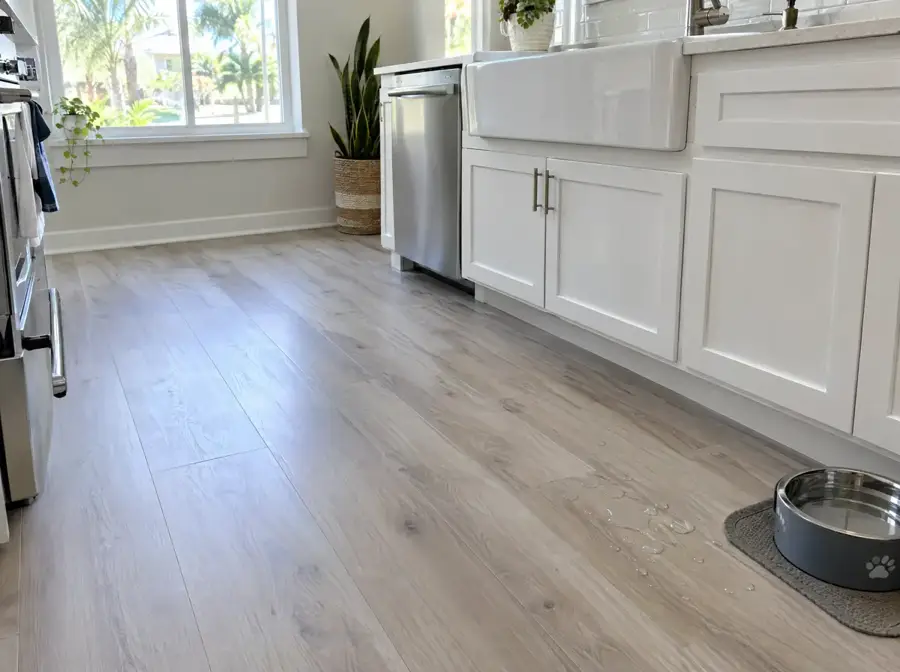
- Waterproof means the plank doesn’t absorb water. Water-resistant means it holds off water for a limited time.
- Laminate warranties typically exclude standing water, leaks and flooding.
- Waterproof plank still needs water under it dried quickly.
- FEMA doesn’t class floating vinyl plank as flood damage-resistant.
Two labels, two different promises
Flooring boxes use “waterproof” and “water-resistant” as if they were close cousins. They describe different things. A waterproof plank is made of materials that don’t absorb water, so the plank itself won’t swell, soften or come apart when it gets wet. A water-resistant floor is built to shed water for a limited time, as long as the water is wiped up before it works its way into the joints and the core.
Neither word tells you what happens to the concrete, the walls or the baseboards around the floor. The details sit in the maker’s warranty, and it’s worth reading before you buy.
What waterproof means on vinyl plank
Rigid-core vinyl plank with an SPC core is made mostly of limestone and PVC. Water doesn’t soak into it. That’s the basis for the waterproof label, and it’s a real advantage in a Florida house.
The warranties spell out the scope. The COREtec Plus warranty, for example, says the product won’t swell, cup or crack from normal cleaning, everyday household spills, or moisture from the subfloor. It also says the coverage applies to topical moisture as long as the water doesn’t flow over the edge of the surface, such as at the edge of the room or at cut boards. And it warns that while moisture won’t affect the plank, excess moisture that builds up under or around a floor can lead to mold or mildew, especially if it goes unnoticed.
So waterproof describes the plank. When water runs under the floor at a wall or a tub, the plank will be fine, but the slab and the space under the floor still need to dry.
What water-resistant means on laminate and wood
Laminate and engineered wood have wood-based cores. Manufacturers add sealed edges and tight joints to slow water down, which is what “water-resistant” usually means. The Pergo Classics residential warranty is a clear example. It covers moisture from damp mopping and everyday household spills “when removed promptly”, and it excludes flooding, standing water, leaking pipes, mechanical failures and appliance leaks. Its care instructions say not to let topical moisture sit for longer than 30 minutes.
That’s a reasonable promise for a dry bedroom. It’s a narrow one for a kitchen with an ice maker, a bathroom, or a family room next to the pool door.
Side by side
| Waterproof SPC vinyl | Water-resistant laminate | |
|---|---|---|
| Core | Limestone and PVC | Wood fiber |
| Everyday spills | Covered | Covered if wiped up promptly |
| Pet accidents | Plank won’t swell | Risk at the joints |
| Damp slab | Within maker’s limits | Needs a barrier, still vulnerable |
| Leaking pipes and appliances | Plank survives, area must dry | Typically excluded |
| Floodwater | Not flood damage-resistant | Not flood damage-resistant |
Where the difference shows up in Florida
In South Florida homes, water rarely arrives as a flood. It arrives as everyday events:
- A supply line under the kitchen sink or behind the toilet that starts to drip.
- An ice-maker or dishwasher line that fails while the family is out.
- A clogged AC condensate drain in the hall closet.
- Wet feet and towels coming in from the pool.
- Rain blown in at a slider during a summer storm.
- A slab that gives off moisture from the ground below.
A waterproof plank handles every one of these without swelling. The water still needs to be dealt with. The EPA notes that if wet materials are dried within 24 to 48 hours of a leak or spill, mold usually won’t grow. With a waterproof floor, drying is the whole job. With a water-resistant floor, the floor itself may need replacing too.
Condos add a second angle. In a building, water doesn’t stay in one unit. A failed supply line upstairs can reach the unit below, and a leak in your kitchen can reach your neighbor’s ceiling. A waterproof floor won’t stop water from traveling through a building, but it does mean your own floor is far more likely to come through a small leak intact once the area is dried. Many associations also have their own rules about floor coverings and underlayment. We help with the approval paperwork and we’ll match the rating your association requires. See condo flooring installation.
What neither label covers
Waterproof covers spills, leaks, pets, humidity and a damp slab. Standing floodwater and storm surge are a different matter. FEMA’s Technical Bulletin 2 lists which materials are acceptable as flood damage-resistant below the base flood level. Vinyl sheets and tiles make the list only when they’re homogeneous and set with chemical-set adhesives on concrete. Laminate and engineered wood are rated unacceptable. A floating vinyl plank floor isn’t installed the way FEMA’s acceptable rating describes, so we don’t sell it as a flood product.
After a flood, a hurricane or a roof leak, the space has to be dried and repaired by the right trade before any new floor goes in. We handle the new floor once that’s done. See water-damaged floor replacement and replacing floors after a hurricane.
Getting the most from a waterproof floor
Installation decides how well a waterproof floor performs around water. The expansion gap at the walls is covered by baseboard or quarter round, and in wet rooms the edges at tubs and showers are finished according to the maker’s instructions. Transitions at sliders are fitted so blown-in rain doesn’t run straight under the floor. On a ground-floor slab, we lay any vapor retarder the product calls for.
After installation, a few habits help:
- Wipe up water promptly, especially along walls, tubs and sliders.
- Check under sinks and behind appliances now and then for slow drips.
- Keep the AC condensate drain clear.
- If a leak does run under the floor, get the area dried quickly.
We only install vinyl plank in enclosed, climate-controlled rooms. Open-air lanais and pool decks aren’t a place for it. See vinyl plank in a Florida room for where it works.
Choosing with the labels in mind
When you compare floors, look past the front of the box. Ask what the core is made of, what the warranty says about spills, leaks and subfloor moisture, and what it excludes. For most rooms in a Florida home, a waterproof SPC core is the safer choice. That’s the floor we install, with 6, 12 and 20 mil wear layers. 20 mil is the one for kids, pets and heavy traffic.
As an estimate, waterproof vinyl plank runs $5 to $12 per square foot installed, before your discount. A 200 square foot room is roughly $1,200 to $1,900 before the discount. Our Limited Lifetime Warranty covers you as the owner and doesn’t transfer to the next buyer. Learn more on the waterproof flooring installation page, or read the best flooring for Florida humidity.
Sources: COREtec Plus warranty (waterproof and pet coverage terms) · Pergo Classics laminate residential warranty · FEMA NFIP Technical Bulletin 2: flood damage-resistant materials · EPA: a brief guide to mold, moisture and your home.